
Introduction
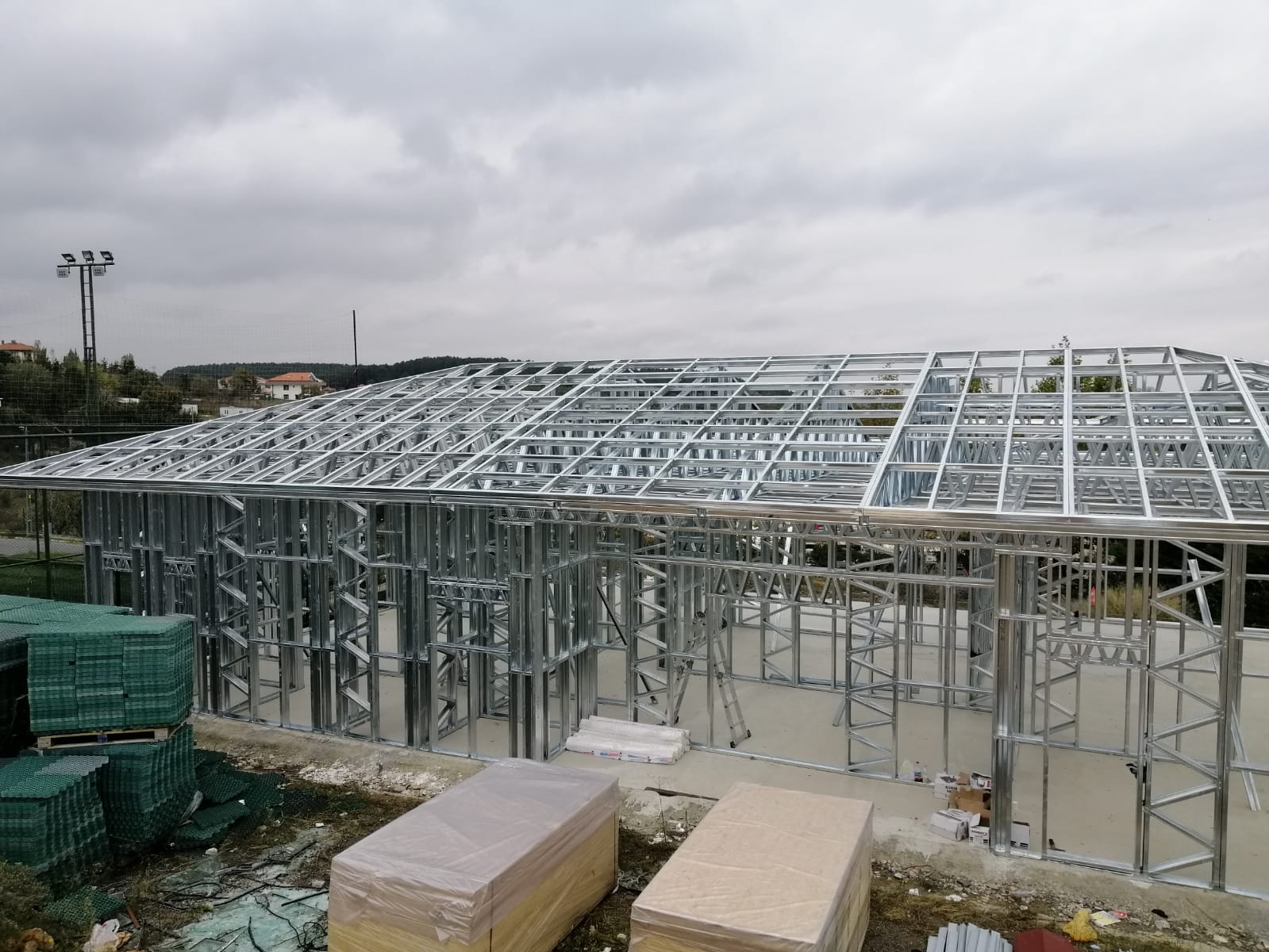
In U.S. structural engineering, two primary design methodologies ensure structural safety in steel construction: Allowable Strength Design (ASD) and Load and Resistance Factor Design (LRFD). These methods are especially important in the design of cold-formed steel framing systems, which are the thin-walled steel studs, joists, and tracks used in modern construction. Both ASD and LRFD are recognized by U.S. building codes and integrated through reference standards like AISI S100 (North American Specification for the Design of Cold-Formed Steel Structural Members). Understanding ASD and LRFD – their philosophies, how they’re applied to cold-formed steel design, and their role in code compliance – is crucial for engineers, builders, and clients aiming for safe, code-approved steel framing projects.
What is ASD (Allowable Strength Design)?
Allowable Strength Design (ASD) is a traditional structural design method that uses a safety factor to ensure stresses or forces in a member do not exceed an allowable limit. In ASD, engineers work with service-level loads (actual expected loads like dead weight, live loads, wind, etc.) and compare resulting stresses or member forces to permissible values. The design is deemed safe if calculated stresses or forces remain below the material’s allowable strength. These allowable strengths are obtained by taking the nominal capacity of an element and dividing by a safety factor (Ω), which provides a margin of safety to cover uncertainties in loads, material properties, and construction. This approach, historically known as “Allowable Stress Design” or “Working Stress Design,” was one of the earliest used in structural engineering. It remains in use for its simplicity and familiarity, especially in straightforward designs. For example, in cold-formed steel, an engineer might calculate the bending stress in a steel stud under service loads and ensure it is less than the steel’s allowable bending strength (which is the steel’s yield strength divided by a safety factor). If the stress is within the allowed limit, the member passes ASD criteria for that load combination.
Under ASD, load combinations (as defined in standards like ASCE 7) are typically un-factored or only subtly adjusted combinations of service loads that represent realistic scenarios (e.g., D + L, D + W, etc., where D=dead load, L=live load, W=wind). Because the loads are not amplified, the safety margin is introduced by reducing the capacity. For instance, AISI S100 might specify Ω (omega) factors around 1.67 to 2.0 for cold-formed steel member strength, meaning the member’s nominal strength is divided by this factor to get an “allowable” strength. In summary, ASD provides a time-proven, straightforward way to design steel elements by ensuring service loads do not overstress the structure beyond a conservative allowable limit.
What is LRFD (Load and Resistance Factor Design)?
Load and Resistance Factor Design (LRFD) is a more modern limit-states design approach that became widely adopted in U.S. codes as an alternative (and companion) to ASD. LRFD incorporates reliability-based design principles, explicitly considering the variability in loads and material strengths by using factored loads and resistance factors. In LRFD, the design process involves amplifying the nominal loads by certain factors (greater than 1.0) to account for uncertainty and potential extreme events, and simultaneously reducing the nominal resistance (capacity) of members by a factor (φ, phi) to account for variability in material strength and construction. The structure is considered adequately designed if the factored resistance of each member (φ * nominal strength) meets or exceeds the effect of factored loads (the demand). This method ensures a consistent level of reliability across different types of loads and materials by calibrating the load factors and phi factors based on probabilistic analysis and past experience.
In practice, LRFD uses load combinations with factors specified by codes (e.g., a common load combo from ASCE 7 for strength design: 1.2D + 1.6L + 0.5S for dead, live, and snow loads). Each load type (dead, live, wind, seismic, etc.) has a factor reflecting its uncertainty – for example, live loads might have a higher factor than dead loads because they are less predictable. On the resistance side, cold-formed steel design per AISI S100 assigns φ factors (phi) typically in the range of about 0.8 to 0.95 for member capacities. For instance, if a cold-formed steel beam has a nominal moment capacity of M<sub>n</sub>, the design using LRFD would consider φ * M<sub>n</sub> (with φ perhaps 0.90 for bendingand ensure this is greater than the bending moment demand from factored loads (say, 1.2 * dead moment + 1.6 * live moment, etc.). LRFD’s philosophy thus distributes safety across both sides of the equation – increasing loads and reducing strengths – which is seen as a more uniform and rational way to achieve target reliability levels. It has become the predominant design method in modern U.S. steel design codes due to these advantages, though in practice engineers may choose either LRFD or ASD based on preference or specific project requirements.
Design Philosophy Differences: ASD vs LRFD
Conclusion
ASD and LRFD are both integral to U.S. structural design practice, offering two paths to the same goal: a safe and efficient structure. In the realm of cold-formed steel framing design, these methods are codified in AISI S100 and thus in the building codes, providing engineers the flexibility to use either approach without sacrificing compliance or safety. ASD, with its use of safety factors and allowable strengths, continues to be a reliable method favored for its simplicity and direct use of service loads. LRFD, with its factored loads and resistance factors, represents the modern reliability-based philosophy that dominates most current design standards. Understanding the differences in philosophy (safety factor vs. resistance factor) and calculation (service load combinations vs. factored load combinations) between ASD and LRFD helps professionals make informed decisions and communicate with clients about how their structure is being designed.
For U.S.-based construction professionals and clients evaluating steel framing systems, the key takeaway is that both ASD and LRFD, when used in accordance with AISI S100 and the IBC, will result in a safe, code-approved cold-formed steel structure. The choice of method may influence the design process and perhaps some aspects of the member sizes or connections, but either way the design will have the necessary safety margins. What’s crucial is employing qualified engineers who use the latest AISI Manual and specifications, understand building code requirements, and apply the chosen design method correctly. By doing so, one ensures the resulting steel framing system achieves the desired performance, meets all building code mandates, and stands strong throughout its intended life – embodying the principles of structural safety and reliability that ASD and LRFD were developed to uphold.